
The Necessary Disruption Behind Perfect Putting Greens
For golfers across the UK, the arrival of hollow-tining can produce a familiar collective sigh. After a summer of competitions, society visits and regular club play, members naturally want to see smooth, quick greens remain available for as long as possible. A few weeks of visible holes, sandy surfaces and less predictable ball roll can feel like an unwelcome interruption to the golfing calendar.
Yet the disruption is neither arbitrary nor cosmetic. Autumn aeration is one of the most important safeguards in the annual maintenance programme. Beneath every putting surface, roots, soil particles, organic matter, water and air are engaged in a constant balancing act. The underlying relationship between aeration and soil condition is documented by an Authoritative Source on soil aeration and compaction. By opening the rootzone at the right time, the greenkeeping team relieves accumulated pressure, improves drainage and prepares the turf to withstand the difficult winter period. The short-term sacrifice in surface perfection provides the foundation for healthier, firmer and truer-running greens when spring fixtures return.
Relieving the Hidden Weight of Foot Traffic and Heavy Machinery
A green experiences a remarkable amount of pressure during a long season. Thousands of footsteps concentrate wear around hole locations, entrances and popular lines of approach, while rollers, mowers, utility vehicles and other maintenance equipment repeatedly pass over the same carefully prepared ground. Even when a surface looks sound, the soil beneath it can gradually become compressed. The spaces between particles become smaller, and the rootzone loses the open structure needed for air and water to move freely.
This compaction is particularly significant on fine turf, where a dense, close-cut surface leaves little room for error. Healthy soil contains a mixture of larger macropores and smaller micropores. Macropores allow excess water to drain and provide routes for oxygen, while micropores retain enough moisture for roots to access between rainfall events. Repeated traffic squeezes the larger spaces first. The result can be a rootzone that holds water at the surface, drains slowly and becomes increasingly difficult for roots to penetrate.
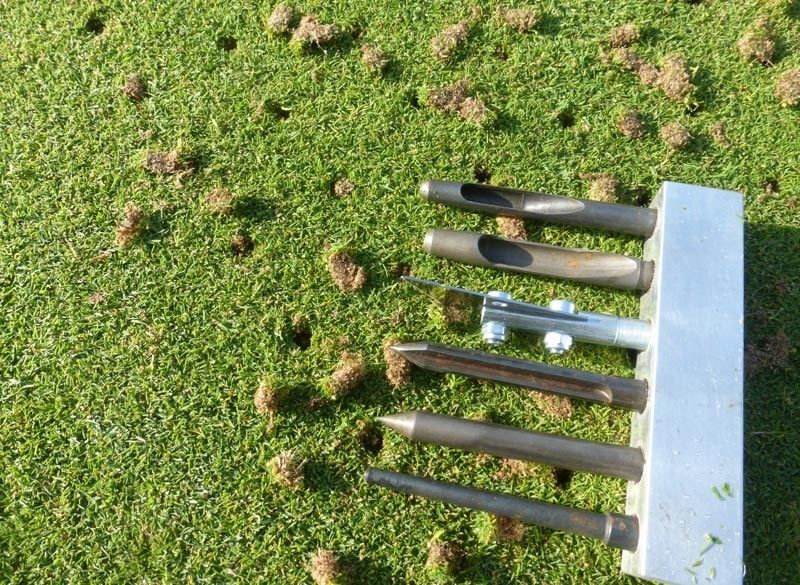
Autumn cultivation breaks this downward cycle in two principal ways. Solid tining pushes narrow, unbroken channels into the soil, opening routes for air and water without removing material. Hollow-tining, or coring, extracts plugs from the rootzone. That physical removal is especially valuable where compaction and organic accumulation have created a dense layer. The extracted cores can be collected, the surface can be cleaned, and suitable topdressing can then be worked into the openings.
- Solid tining creates temporary channels with comparatively little surface disturbance and is useful when the rootzone needs ventilation without significant material removal.
- Hollow-tining removes compacted soil and accumulated organic matter, giving the greenkeeping team a more direct way to correct the profile.
- Deep or targeted aeration can address compaction below the immediate surface, although the method must be selected according to soil type, moisture and turf condition.
The causes and consequences of this process are explained in this soil aeration guidance, which outlines how traffic reduces pore space and why cultivation is needed to restore the physical condition of fine-turf soils. The precise machinery and depth used on a particular green will depend on local conditions, but the agronomic principle remains straightforward: a compacted rootzone cannot consistently support strong roots and a reliable playing surface.
Restoring Gas Exchange in the Active Rootzone
Turfgrass roots are living tissues, not passive anchors. They respire continuously, taking in oxygen and releasing carbon dioxide as they use stored sugars to support growth, repair and nutrient uptake. For that exchange to occur, the soil must contain connected air-filled pores. When those pores are crushed or filled with water, oxygen becomes scarce and carbon dioxide accumulates. Root activity slows, fine roots decline and the turf becomes less able to recover from wear.
The difference between an open and compacted rootzone can be considered in practical terms. A healthy profile allows rain to move downwards, air to replace it and roots to explore a useful volume of soil. A compacted profile behaves more like a sealed layer. Water may remain close to the surface, roots may become shallow and the plant can be placed under stress even when the grass appears green. Aeration restores the physical connections that make gas exchange possible.
| Rootzone condition | Likely turf response | Effect on playing quality |
|---|---|---|
| Open pore structure | Improved oxygen supply, drainage and root exploration | Firmer footing and more consistent ball roll |
| Compacted pore structure | Restricted air movement, slower drainage and shallow rooting | Soft surfaces, increased wear and less reliable recovery |
| Waterlogged surface layer | Reduced oxygen and greater stress on roots | Greater vulnerability during prolonged wet weather |
Autumn is therefore about more than making holes in a green. It is about renewing the relationship between the turf canopy and the rootzone below it. Once the channels are open, rainfall has a better route away from the surface and atmospheric oxygen can enter the profile. This does not remove every drainage problem, nor can it compensate for unsuitable construction or poor management, but it gives the grass a far better platform from which to face winter.
Managing Thatch and Winter Moisture Infiltration
Thatch is a layer of living and dead stems, roots, stolons and other organic material that develops between the grass canopy and mineral soil. A modest amount can contribute to resilience, but excessive thatch creates a troublesome sponge-like layer. It can retain water near the surface, restrict infiltration and encourage the soft, humid conditions in which turf disease becomes more difficult to manage. It can also make the green feel springy underfoot rather than firm and dependable.
Hollow-tining provides a direct means of removing part of this accumulated organic material. The operation is normally followed by collection, brushing and topdressing, with the exact sequence adjusted to the condition of the surface. Removing cores in autumn is particularly useful because it creates time for the remaining turf to recover before the most persistent winter weather arrives. Good aeration will not, by itself, prevent every outbreak of disease such as Microdochium patch, but it can reduce the prolonged surface wetness and poor airflow that make disease management more challenging.
The holes also become valuable pathways for sand and air. Kiln-dried sand is commonly used for topdressing because it is dry, free-flowing and easier to work into narrow channels. When brushed into the surface, it can form small, more durable drainage columns rather than leaving open holes that quickly collapse. This improves continuity between the surface and the rootzone while helping to restore a firmer, more even layer as the turf recovers.
- Assess the green first. Soil moisture, thatch depth, rooting, compaction and recent weather all influence the appropriate aeration method.
- Remove or disperse the cores. Extracted material should not be left to form a new uneven layer on the playing surface.
- Apply compatible topdressing. Sand or another approved material is selected to complement the existing rootzone rather than create a sharp textural difference.
- Brush and settle the surface. Working the dressing into the channels helps maintain the benefit after the initial operation.
- Manage recovery carefully. Irrigation, nutrition, mowing height and traffic are adjusted so that the grass can knit together without unnecessary stress.
The relationship between cultivation, compaction and permeability is set out in these compaction cultivation guidelines. For members, the practical message is reassuring: the untidy appearance immediately after coring is part of a controlled process. The objective is not simply to create holes, but to remove unwanted organic material and replace lost pore space with a more stable, better-draining structure.
Why Timing Autumn Maintenance Is Essential for Swift Recovery
The timing of autumn aeration is a careful compromise. Soil can remain warm enough to support root and crown activity, while cooler air reduces excessive top growth and limits the stress associated with hot, dry conditions. In a suitable September or October window, the turf has a realistic opportunity to heal, produce new growth around the channels and settle the topdressing before winter becomes dominant.
Leaving the operation too late can make recovery less predictable. Open holes may be exposed to repeated frost, saturated conditions and cold winds, while biological activity slows as soil temperatures fall. The same work that might knit together in roughly a fortnight during favourable early autumn weather may take considerably longer later in the season. Early planning therefore protects both the agronomic outcome and the playing calendar, allowing the greenkeeping team to complete necessary work before major fixtures and periods of sustained winter stress.
A two-week recovery window is not a rigid promise, since grass species, weather, soil type and the extent of cultivation all matter. It is better understood as a useful planning principle. When autumn conditions are favourable, a brief pause or controlled reduction in play can achieve a much better result than postponing the work until spring, when aeration would compete with rising fixture demands and the desire for immediately polished putting surfaces.
Reaping the Rewards of Firm and Resilient Greens Next Spring
Autumn coring asks golfers to tolerate a temporary decline in visual finish and ball-roll consistency. That patience has a direct return. By relieving compaction, improving gas exchange, managing thatch and helping winter rainfall move through the profile, aeration gives the turf a stronger chance of emerging in spring with healthier roots and a more resilient surface. The smoothness seen in April is not created in April alone. It is built through decisions made months earlier.
For members, visitors and society golfers, the most useful perspective is to see hollow-tining as shared club stewardship. The greenkeeping team is carrying out precise subterranean work that may be difficult to appreciate from the putting surface, but its effects are felt in firmer footing, more reliable pace and truer lines when the new season gathers momentum. A short period of patience in autumn protects the quality of future rounds, supports the long-term health of the course and helps preserve the standards expected of a well-run Yorkshire golf club.