

When the West Yorkshire Canopy Closes In
A stray drive into a dense West Yorkshire tree line creates a familiar parkland dilemma. The ball may be visible beneath overhanging branches, but visibility is not the same as a practical route to the green. Summer rough can hold the ball down, tree roots can restrict the stance, and a narrow gap between trunks can tempt even a sensible medal player into attempting far more than the lie allows. Whether tackling a tight parkland track or reviewing your card after consulting Cleckheaton Golf Club’s course scorecard, making quick, confident relief choices protects your medal score.
The danger is often less the original mistake than the response to it. A heroic punch shot through foliage might succeed occasionally, but a ricochet into another thicket, a damaged club, or a lost ball can turn one poor drive into a double or triple bogey. Rule 19 offers a calmer alternative. It is not an admission that the round has gone wrong; it is a recognised tactical option that lets you accept one penalty stroke, reset the situation, and continue with a realistic chance of limiting the damage. Understanding your baseline rights under the official Rules of golf allows club golfers to navigate tricky parkland layouts with calm authority.
The Golden Rule of Who Decides an Unplayable Lie
The first point to settle is straightforward but important: only the player may decide that their ball is unplayable. A playing partner, caddie, marker, or opponent cannot declare the ball unplayable on the player’s behalf. If the ball is in a bush, wedged against a tree, sitting on exposed roots, or simply in a position from which the player does not wish to play, the player can choose Rule 19 relief, subject to the rule’s limits.
This prevents a common misunderstanding in club golf. A marker may offer an opinion, and a fellow competitor may question whether the correct procedure has been followed, but neither can force a player to take relief or insist that a difficult ball must be played. The decision should be made before the next stroke, with the penalty and chosen relief option understood clearly. If doubt remains during a competition, the safest approach is to pause, involve the marker or competition committee where appropriate, and avoid moving the ball until the procedure is settled.
Rule 19 generally applies anywhere on the course except a penalty area. If the ball lies in a red or yellow penalty area, the relevant relief is provided by Rule 17, not by declaring the ball unplayable under Rule 19. This distinction matters beside streams, ponds, drainage channels, and marked environmental features. In ordinary situations, Rule 19 provides three standard options, each costing one penalty stroke:
- Stroke-and-distance relief, returning to the place of the previous stroke.
- Back-on-the-line relief, dropping behind the original ball position on a line from the hole.
- Lateral relief, dropping within two club-lengths of the original ball position, no nearer the hole.
Bunkers have additional restrictions. Lateral and back-on-the-line relief under the ordinary one-stroke options will generally keep the ball in the bunker. A player may take back-on-the-line relief outside the bunker, but that option carries two penalty strokes. The rule is therefore generous in providing choices, but it still requires careful attention to the area in which the ball lies and the relief procedure selected.
Evaluating Your Three Standard Relief Options
Stroke-and-distance is the most familiar route and is often the cleanest choice when the original ball is trapped deep in woodland. Add one penalty stroke and play from the spot where the previous stroke was made. This option is also available when the original ball has not been found, provided the situation is dealt with under the appropriate lost-ball procedure. In practical terms, it gives up distance but removes the uncertainty of trying to escape from an unplayable lie.
Back-on-the-line relief can be particularly useful when the original ball is visible and there is open ground behind it. Imagine a ball resting beneath branches on the right side of a fairway. A line is established from the hole through the original ball position and extended backwards. The ball must be dropped on that line, and the relief area extends one club-length from the chosen reference point. The player may go back as far as desired on the line, which can create a substantially better lie, although the available ground and the direction of the line must be checked carefully.
Lateral relief is measured from the spot where the ball lies, using two club-lengths, with the ball dropped within the resulting relief area and not nearer the hole. The reference point is the original ball position, not the point where the ball is eventually dropped. For measuring relief, the longest club carried by the player during the round is used, excluding the putter. A driver is therefore commonly used, even if the next shot will be played with a wedge or short iron.
| Relief option | When it often helps | Key point to check |
|---|---|---|
| Stroke and distance | The lie is buried, blocked on every side, or too risky to escape | Return to the previous stroke location and add one penalty stroke |
| Back on the line | There is usable ground behind the original ball on a clear line from the hole | The reference line runs from the hole through the original ball position |
| Lateral relief | There is better open ground to one side of the original lie | Use a two-club-length area, no nearer the hole |
The best choice is rarely the one that travels furthest. It is the option that gives the next stroke the highest chance of being controlled. Visiting golfers preparing for tight fairways often consult Cleckheaton Golf Club Reviews (2026) – Cleckheaton Golf, Scorecards & Visitor Information before teeing off in medal competitions, but course familiarity should always be paired with a careful assessment of the actual lie on the day. Wet ground, thick rough, low branches, and the position of the green can all change the sensible decision.
The Step-by-Step Procedure for a Valid Knee-High Drop
A correct decision can still become a rules problem if the drop is made carelessly. Before lifting the ball, identify and mark the original reference point. This is particularly important for lateral relief, where the two-club-length area is measured from the ball’s original position, and for back-on-the-line relief, where the chosen point on the line determines the relief area. A tee is useful, although another suitable marker can be used in accordance with the applicable procedure.
- Identify the correct relief option and add the required one penalty stroke.
- Mark the original ball position or the selected reference point, depending on the relief procedure.
- Measure the relief area with the longest club carried during the round, excluding the putter.
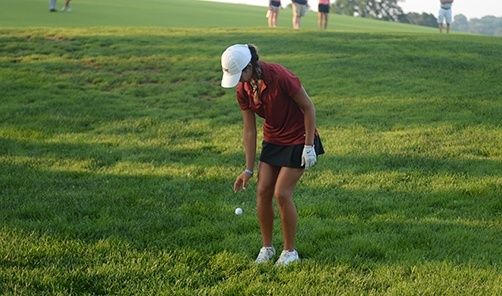
- Drop the ball from knee height so it falls straight into the defined relief area.
- Check where the ball comes to rest and confirm that it remains inside the relief area and is not nearer the hole than permitted.
The modern procedure requires the ball to be dropped from knee height, meaning approximately the height of the player’s knee when standing upright. It is not rolled, tossed from shoulder height, or placed by hand. The ball must come to rest in the relief area. If it rolls outside that area, nearer the hole than the relevant reference point, or into another prohibited position, the drop must be repeated according to the rules. If a second drop also fails, the ball is placed at the spot where it first touched the ground on the second drop.
Strategic Arithmetic Over Wishful Thinking
Rule 19 becomes most useful when viewed through simple scoring arithmetic. Suppose a punch shot through a curtain of branches has roughly a one-in-ten chance of reaching a safe part of the fairway. The other outcomes may include a ricochet into deeper woodland, a fresh unplayable lie, a lost ball, or a difficult recovery that still requires another shot. A one-stroke penalty followed by a controlled wedge or iron may produce a far better expected result, even though the penalty feels immediately disappointing.
The calculation should include more than the next shot. A reckless escape can snap a shaft against a trunk, strike a tree and rebound towards the tee, or disappear into rough that cannot be searched efficiently. A lost ball outside a penalty area can also require stroke-and-distance relief, with the additional pressure of finding or replacing the ball within the relevant search procedure. Taking a deliberate Rule 19 option often prevents one mistake from becoming several.
- Assess the lie, stance, intended landing area, and likely rebound before choosing a club.
- Ask whether a successful punch shot would genuinely improve the hole, rather than merely advance the ball a few yards.
- Compare the worst likely result with the guaranteed position offered by a penalty drop.
- Choose the route that preserves a realistic chance of making the next stroke cleanly.
That discipline is valuable in Saturday competitions and monthly medals, when a poor decision can occupy the mind for several holes. The penalty stroke is visible on the card, but so is the damage avoided: no second visit to the trees, no hurried search, no arguments about a provisional ball, and no forced recovery from an even worse lie. A firm decision also supports pace of play. Once the player has established the reference point and relief area, the ball can be dropped and the round can continue without an extended debate beside the tree line.
Turn Penalty Strokes into Saved Scorecards
Rule 19 gives golfers a practical way to take control when the course presents an awkward lie. The decision remains with the player, the penalty is known in advance, and the three standard options allow the recovery to be matched to the situation. Stroke-and-distance may sacrifice distance, back-on-the-line may provide a useful angle, and lateral relief may create the best balance between position and convenience. The important habit is to compare the actual options rather than allowing pride to select the most spectacular one.
Quick, accurate decisions protect both score and enjoyment. Mark the reference point, measure with the correct club, make a knee-high drop, and confirm that the ball has finished within the relief area. A sensible penalty is often cheaper than a failed hero shot, and it leaves the golfer with a clear next task rather than another problem to solve. Manage the miss with the same care given to a good drive, and even a difficult walk through the West Yorkshire trees can remain a composed, enjoyable round.